


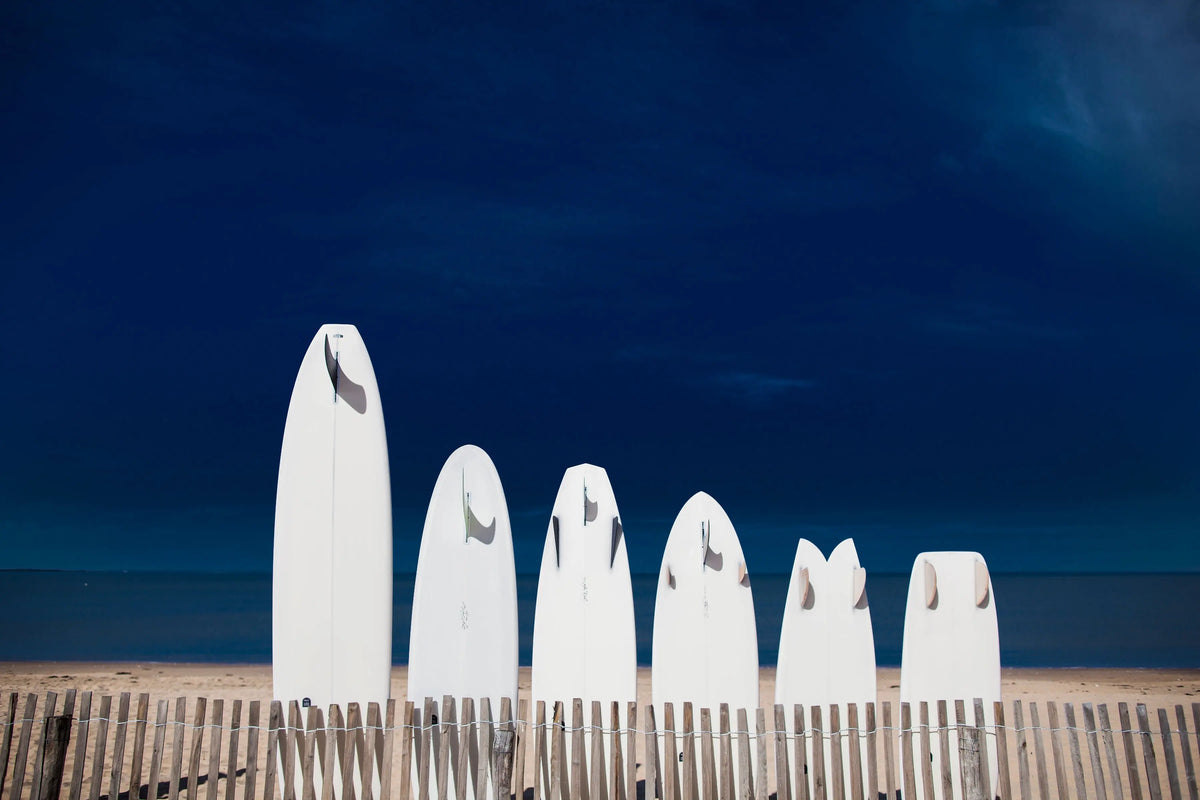
We talk a lot about the board, rarely about the fins. This is a mistake. Three pieces of material under the deck change a board's behavior more than most people imagine: the same shape does not surf the same in twin, thruster, or quad setups. Before diving into fine technical details (that's for Part 2), we need to establish the basics. This article lays them out.
What a fin actually does
A fin does three things simultaneously:
- It grips. Without it, the board slides sideways and drifts. The fin anchors the tail in the water and allows you to hold a line.
- It pivots. It's the fulcrum around which you turn. The larger and further back the fin, the longer and more stable the turn; the smaller and further forward, the more reactive it is.
- It releases or holds. Depending on its rigidity and surface area, it either releases the tail during maneuvers (drift) or locks it in (drive).
Any fin choice is a trade-off between these three forces. There is no "best" fin; there is a fin suited to your board, your weight, your skill level, and the wave you're surfing.
Fin Box Systems
Before the shape, there's the fin box. Three main families cover most of what you'll encounter:
FCS II — the standard for recent shortboards. Tool-free installation and removal: you clip it in, you take it out. Convenient for everyday use, and compatible with original older FCS fins via a screw.
Futures Fins — a single fin box system, the fin slides in as one block and is secured with a single screw. Known for its solidity and direct transmission of pressure. Many shapers and demanding surfers prefer it for this reason.
Single Box / US Box — the long box found on longboards and some mid-lengths, where the center fin slides. It allows you to adjust the fin forward or backward to fine-tune maneuverability and drive. This is the system used for 2+1 configurations (see below).
The first two systems are not interchangeable: an FCS II fin will not fit into a Futures fin box and vice versa. Before buying, check which system your board uses.
Fin Configurations
The number and arrangement of fins define the board's character as much as its shape.
- Single (1 fin) — the original. Long, flowing lines, lots of glide, less reactivity. The domain of longboards and classic surfing.
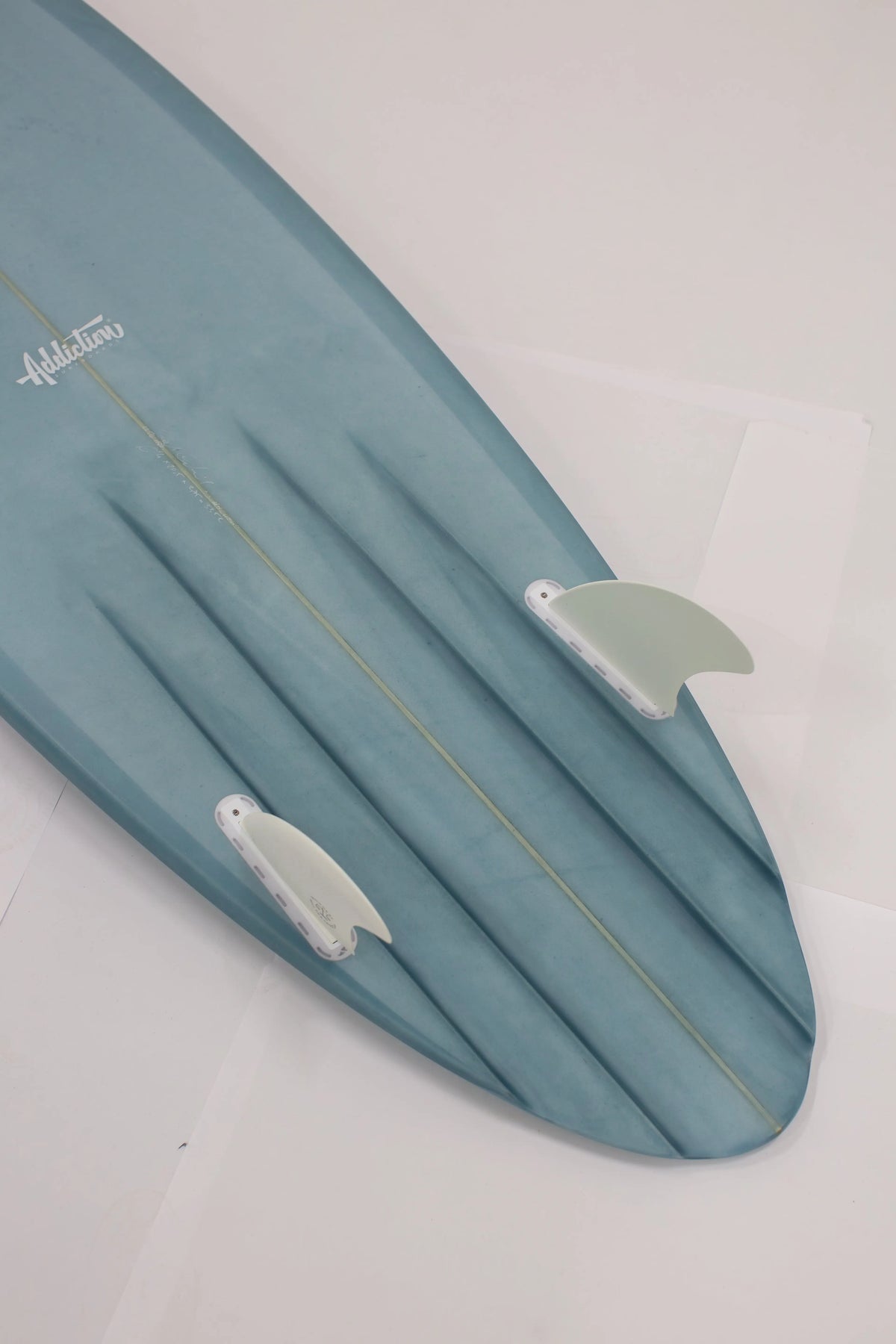
- Twin (2 fins) — fast, lively, playful. The twin setup releases the tail and generates speed in weak to medium waves. It's the queen configuration for fish boards and many mid-lengths.
- Thruster (3 fins) — the benchmark since the 80s. The universal compromise: drive, control, versatility in all types of waves. If you're new to choosing fins, this is the first base to understand.
- Quad (4 fins) — lots of straight-line speed and grip in hollow or fast waves. Less pivotal than a thruster, more "rocket-like".
- 2+1 — a central fin (single box) flanked by two side bites. The configuration for longboards and mid-lengths that want both the glide of a single fin and a bit of the bite of a thruster.
- 5 fins (convertible) — the board has 5 fin boxes: you can surf as a thruster, quad, or twin depending on the day and the wave. Maximum versatility without changing boards.
How to start choosing
Three questions, in order:
- What system does my board accept? (FCS II, Futures, single box) — this immediately eliminates half the catalog.
- How much do I weigh? Manufacturers classify their fins by rider size (S / M / L / XL). Too small = the board slides and lacks hold; too large = it becomes stiff. Weight takes precedence over skill level for this adjustment.
- What wave, what feeling am I looking for? Drive and control in fast waves → stiff fins, more surface area. Liveliness in small waves → more flexible, more release.
This is exactly where the real subject begins — rigidity, foil, rake, toe, and cant — which we detail in the next part.
→ Continue with Part 2 – Exploring the Technicality of Surfboard Fins to dive into fine-tuning.
Unsure about the configuration or size for your board? Visit the surf shop or write to us: we'll sort it out in two minutes, with the board in front of us. See our fin selection
Share:
Introduction to the Repair Service
The Shapers Club's 35th Anniversary: Two Days of Festivities on July 3 & 4