


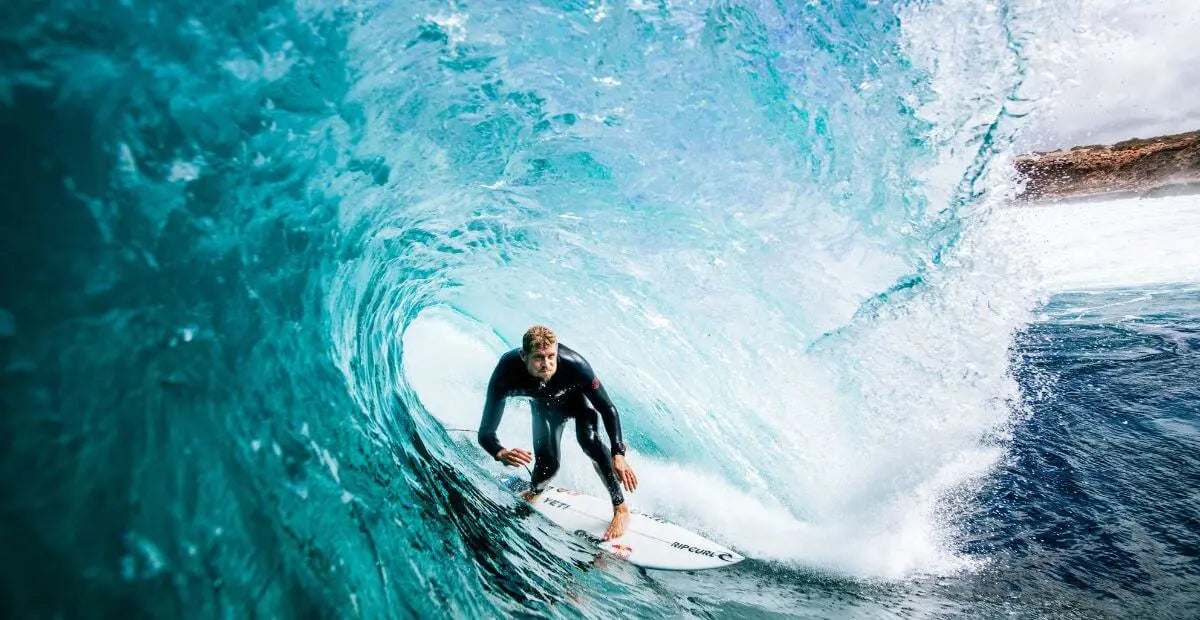
As with wax, it all starts with water temperature. A wetsuit isn't something you keep all year round – it's a thermal tool calibrated for a specific temperature range. Too thick, you overheat and lose mobility. Too thin, you'll be freezing cold after twenty minutes in the water. Here's how to choose the right thickness, season by season, for the Atlantic coast.
How to read wetsuit thickness
Wetsuits are expressed in two or three numbers: 3/2, 4/3, 5/4/3. These represent the neoprene thickness in millimeters.
- The first number = the torso (the core, to be kept warm first).
- The second = the limbs (arms and legs, which need flexibility).
- The third, when present = the extremities on very warm models.
A 3/2 = 3 mm on the torso, 2 mm on the limbs. The higher the numbers, the warmer it is – and the less flexible. The challenge is always the same: warm enough without turning you into a rigid doll.
Summer on the Atlantic Coast
This is the simplest season, and the one where people most often make the mistake of overheating.
Water around 18 to 22°C in mid-summer:
- 3/2 fullsuit → the Swiss Army knife of the Atlantic summer. Flexible, warm enough for long sessions, this is the wetsuit you'll wear most often.
- Shorty / springsuit (2 mm) → for the warmest days, highest water temperatures, and short sessions. Maximum freedom of movement.
- Boardshorts + rashguard → only on rare heatwave days with really warm water. The rashguard mainly protects from the sun and board rub.
Tip: Don't put away your 3/2 too quickly. A June morning or a westerly wind can bring the water temperature back down.
Spring and Autumn
Water between 13 and 18°C — the "in-between" seasons, often the best for surfing, but treacherous in terms of temperature.
- 4/3 fullsuit → the queen of mid-season wetsuits. Warm enough for cool water, still flexible enough for good surfing.
- Depending on your sensitivity to cold and the duration of your sessions, a 3/2 may be sufficient in early autumn when the water is still warm.
Winter
Water below 13°C, cold wind, biting sessions.
- 4/3 or 5/4/3 fullsuit depending on your resistance and the heart of winter.
- Neoprene booties (3 to 5 mm) almost essential.
- Gloves and hood when the water drops below ~10–11°C.
In winter, it's not just about the wetsuit: it's a complete system. And that's also when ear protection becomes non-negotiable.
→ See our guide to earplugs and ear protection to get through winter without damaging your eardrums.
Summary table — Atlantic coast
| Season | Water (approx.) | Wetsuit | Accessories |
|---|---|---|---|
| Summer | 18–22°C | 3/2, shorty on warm days | — |
| Spring / Autumn | 13–18°C | 4/3 (3/2 in transition) | booties if chilly |
| Winter | < 13°C | 4/3 to 5/4/3 | booties, gloves, hood |
Same logic as for wax: you don't need *a* wetsuit, you need the *right* one for the season. → Choosing your wax according to temperature.
Are you preparing for your season and unsure which thickness to aim for? Wetsuits are available in our shop, categorized by use – and we'll help you find the right one based on when and where you surf.

Share:
Tyler Hatzikian shaping at Shapers Club — pre-orders open
La Cave : 69 shapes signés par nos guest shapers, prêts à glasser — réservez le vôtre