


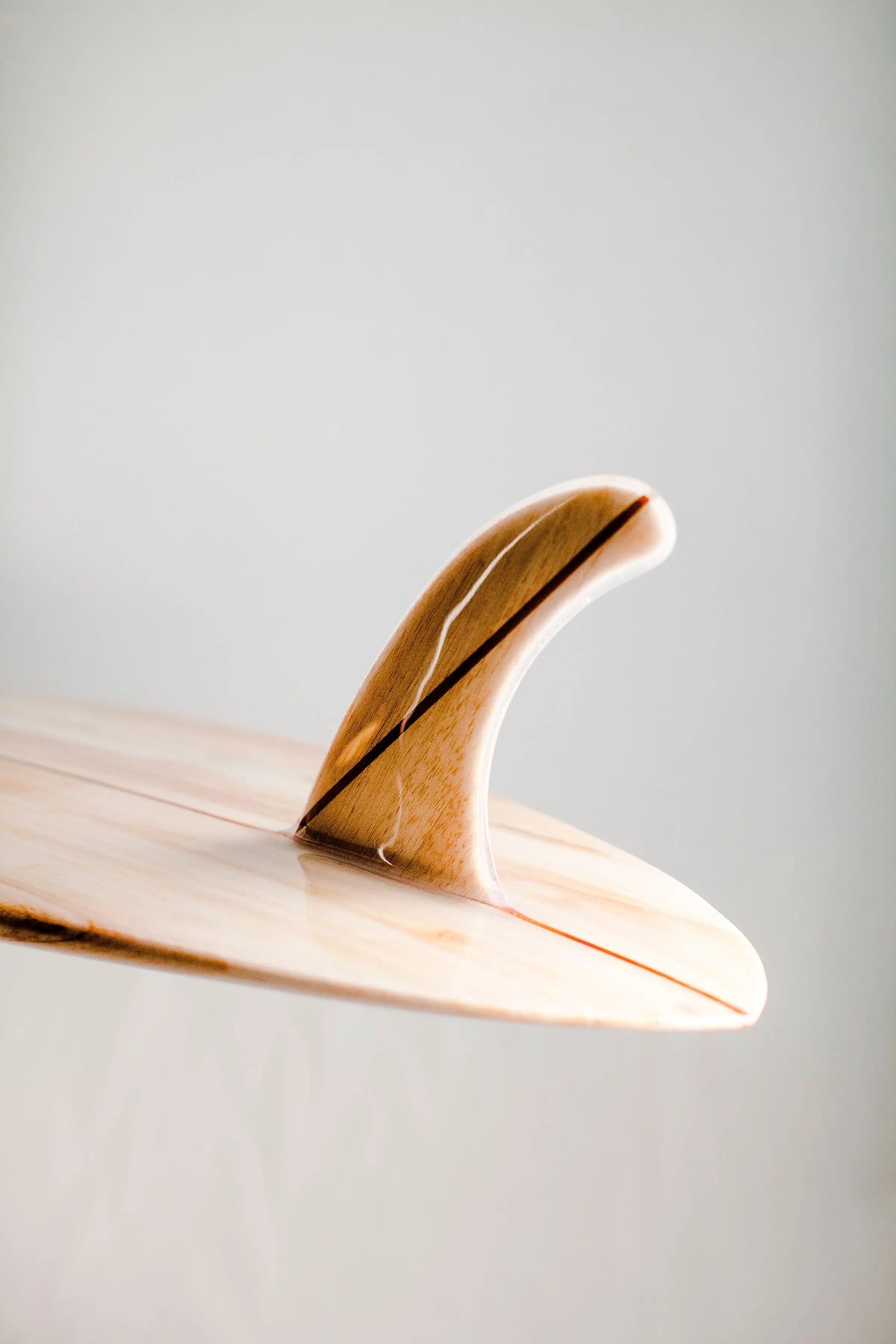
In Part 1, we covered the basics: fin systems (FCS II, Futures, single fin box), configurations (single, twin, thruster, quad), and fin size by rider weight. This is enough to avoid making major mistakes. But it doesn't explain why two sets of thrusters of the same size can provide radically different sensations. The answer lies in fin geometry. Here's the vocabulary – and what each parameter concretely changes under your feet.
Fin Vocabulary
Five measurements define a fin's behavior. Each is a slider between two extremes.
Base — the length of the fin where it attaches to the board. This is the engine of drive: a long base provides strong acceleration and holds the line at speed. A short base makes the board more pivotable, more playful, but with less rebound.
Height (depth) — the depth in the water. More height = more grip and control, ideal in powerful waves. Less height = the tail releases more easily, the board slides out more readily (useful for loose maneuvers and small waves).
Rake (sweep) — the angle at which the fin sweeps back. This is the most telling parameter in terms of turns:
- Lots of rake (fin laid back) → long, drawn-out turns, lots of drive. The domain of fast, hollow, powerful waves.
- Little rake (upright fin) → tight turns under the peak, a lively and reactive board. The domain of small waves and radical surfing.
Cant — the outward tilt of the fin from vertical. More cant = the board engages faster when you get on rail (liveliness), at the cost of a little drive when flat. Less cant (more vertical) = more speed in a straight line. The center fin is almost always 0 cant.
Toe (toe-in) — the angle at which the side fins point inward (towards the stringer). More toe = a more reactive board that engages into turns faster, with a slight increase in drag. Less toe = more speed in a straight line. This is set by the fin boxes on most boards, but it explains some of the feel.

Foil: What happens beneath the surface
Foil is the fin's cross-sectional profile — how water flows over each side.
- Side fins generally have an asymmetrical foil: flat (or concave) inner face, cambered outer face. This asymmetry creates lift outwards, providing drive and speed.
- The center fin of a thruster often has a symmetrical (50/50) foil: it works the same way in both directions, stabilizing without pulling to one side.
You don't have to calculate a foil — but understanding that it exists explains why you don't put just any fin in any position, and why a set is sold as a coherent unit.
Stiffness, flex, and materials
With identical geometry, the material changes everything.
- Stiff fin (solid fiberglass, carbon, performance cores) → immediate response, maximum drive, hold in powerful waves. Predictable, precise. This is what committed surfers look for in good waves.
- Flexible fin / with flex (composites, honeycomb, flexible sections) → the fin loads up in a turn and then springs you out like a coil. More "whip," more forgiveness, more fun in small waves. But less precision when it's pumping.
Many manufacturers combine the two: a stiff base for drive, a flexible tip for rebound. This is often the best versatile compromise.
Area and template: The synthesis
All these parameters are summarized in two concepts:
- Area (total surface) regulates the grip/release ratio. More area = more hold and drive (heavier surfer, big waves, powerful surfing). Less area = more release and maneuverability (lighter surfer, small waves).
- Template (the overall design) combines base, height, and rake into a "personality" that brands often categorize into families: drive (long base, pronounced rake — speed and long lines) vs pivot (short base, upright — tight turns and reactivity). In between are neutral / all-round templates.
How to combine all this according to your surfing
The order of decision, after size (seen in Part 1):
- Your dominant wave type. Fast and powerful → look for drive (long base, pronounced rake, stiff). Mellow and small → look for pivot and flex (short base, upright, flexible).
- The feeling you want to correct. Is your board sliding out and lacking hold? More height / area. Is it too stiff, hard to turn? Less rake, more pivot, a bit of flex.
- The configuration. On a quad, the foil and toe of the front/rear pairs matter immensely (line speed); on a twin, the area and rake alone define the character. → see Twin fins / Mid lengths.
The right approach: only change one parameter at a time and surf it. That's the only way to truly feel what it does.
Fin tuning is felt more than it's read. We keep a wall of fins at the shop, classified by drive / pivot / flex — come, we'll let you try the logic on your own board. See our fin selection.
← Go back to the fundamentals with Part 1: Choosing your fins.
Share:
The Shapers Club's 35th Anniversary: Two Days of Festivities on July 3 & 4
Surfboard rocker: what it really changes