


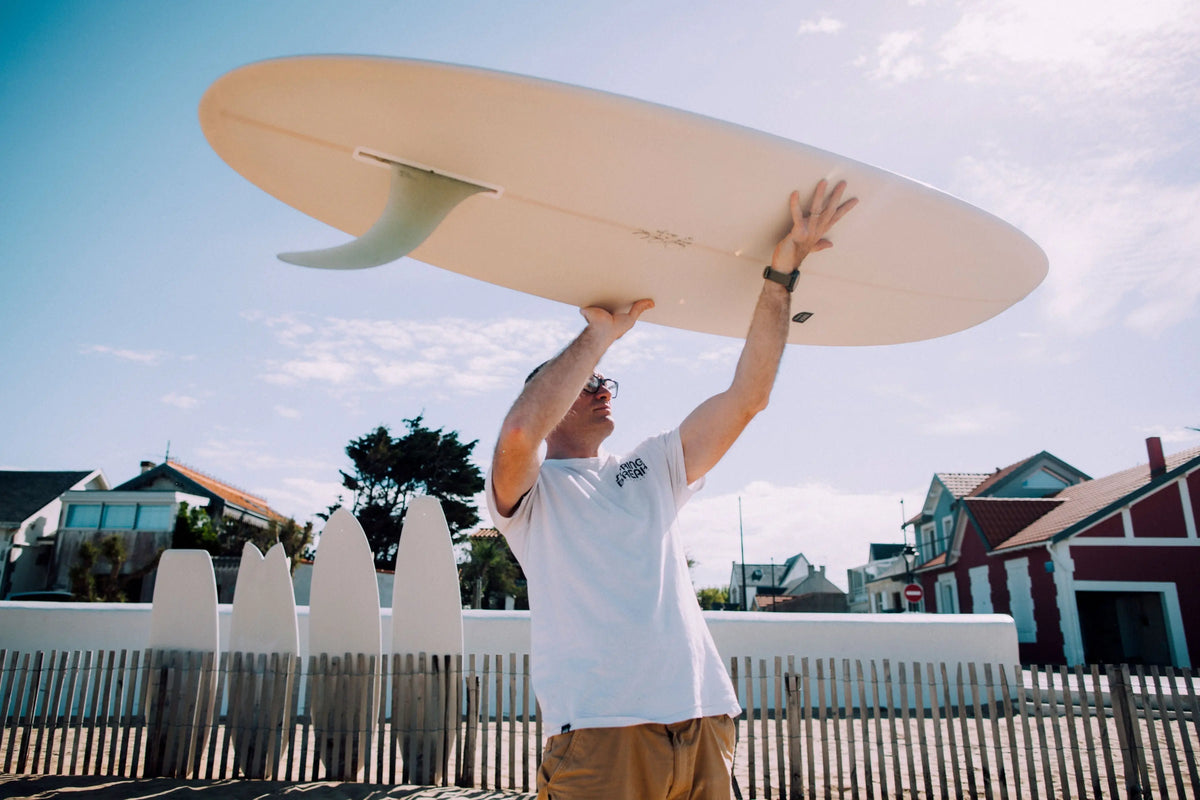
Lay a board flat on the ground. Look at it from the side. It only touches the ground at one or two points: the nose and tail curve upwards. This curve is the rocker. It's one of the most crucial elements of a shape—and one of the most misunderstood. Two boards of the same dimensions with different rockers will surf completely differently.
What is rocker?
Rocker is the lengthwise curvature of the board, viewed from the side. It is measured by how much the front (nose) and back (tail) rise above a horizontal plane.
A board is considered flat when this curve is slight, and curved (or "with strong rocker") when it is pronounced. Between the two, there's a whole world—and it's in these nuances that the board's behavior is determined.
Two areas are always distinguished, and adjusted independently.
Nose rocker vs. tail rocker
Nose rocker (front) manages the board's relationship with the wave's slope.
- Lots of nose rocker → the nose won't dig into hollow or powerful waves. You'll pass steep sections without pearling. But it slows the board down and makes paddling less efficient.
- Little nose rocker → the board paddles strongly, catches waves early, glides well in weak waves. But in a hollow wave, the nose will dive more easily.
Tail rocker (back) manages speed and responsiveness.
- Lots of tail rocker → the back is curved, making it more pivot-friendly, more maneuverable, more comfortable in tight turns and steep waves.
- Little tail rocker → the back is flat, water flows straight off, the board accelerates. More speed, less maneuverability.
The central trade-off: speed vs. maneuverability
All rocker comes down to a single tension:
The flatter a board is, the faster it is and the easier it is to get going. The more curved it is, the more maneuverable and forgiving it is in powerful waves.
In practice, for the Atlantic coast where waves are often weak or medium for much of the year: a flat to moderate rocker paddles better, generates its own speed when the water is calm, and forgives slightly late take-offs. This is what makes a board "easy." Conversely, a board designed for hollow, powerful waves will require more rocker to avoid nose-diving—at the cost of ease in small waves.
There is no universally "good" rocker. There is a rocker that is consistent with the waves you surf most often.
Rocker and bottom shape: they work together
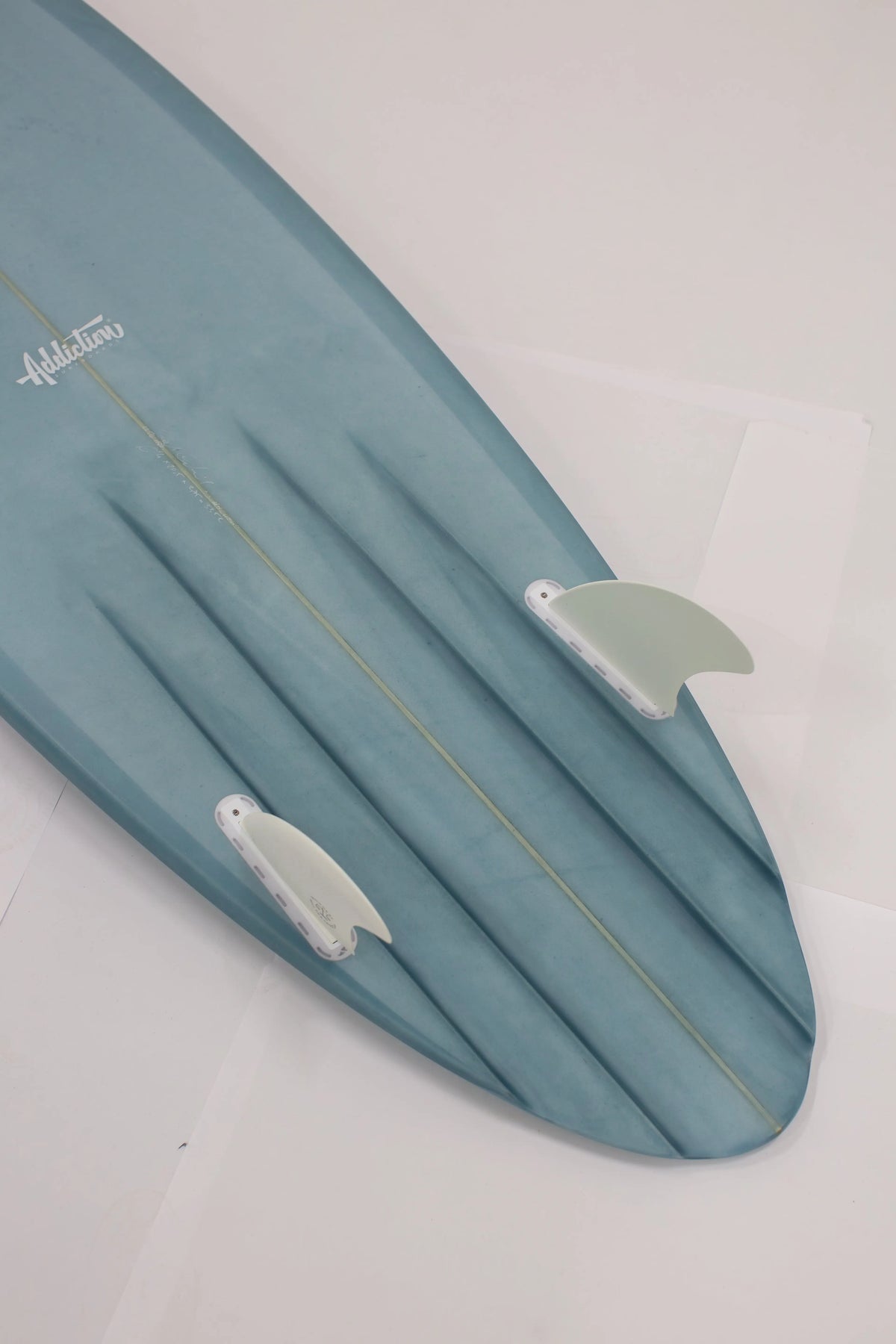
Rocker is never read alone. It interacts with the bottom—the shape of the board's underside (concave, vee, double concave). The bottom manages how water flows under the board; the rocker manages how the board attacks the wave's slope. A pronounced concave can "compensate" for some slowness due to generous rocker by accelerating water flow; a flat rocker with a poorly designed bottom can become uncontrollable at speed.
That's why you never choose a rocker in isolation. You consider it with the bottom and the tail.
→ For the bottom of the board, read our article on bottom shape. → For the tail, see the Board Tail Guide.
Rocker is a custom decision
On a production board, the rocker is fixed—you take what's available. On a custom, it's the opposite: it's one of the first parameters we adjust with you, based on your weight, your skill level, and especially the waves you actually surf.
That's exactly the conversation we have at the Bourgneuf workshop before starting a shape: where you surf, what you want to feel, what's holding you back on your current board. The rocker is decided there, not in a catalog.
Do you want a board tailored for your waves, not for everyone's average? That's the whole point of a custom UWL / Cardinal shaped at the workshop.
Share:
Surf fins: rake, foil, flex and toe (Part 2)
Order your Thomas Surfboards with Thomas Bexon & Jake Bowrey at the Shapers Club House