


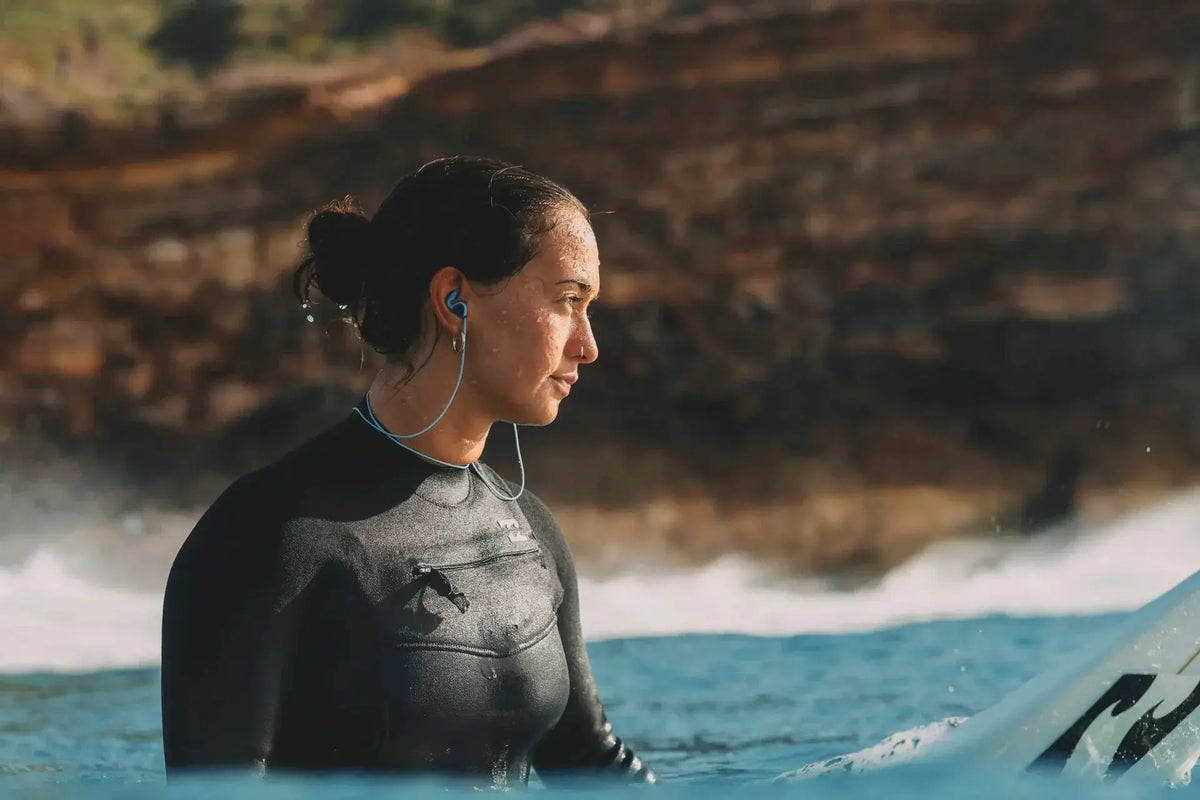
Exostosis—that bony growth in the ear canal caused by repeated exposure to cold water and wind—doesn't happen overnight. It builds up silently over years and eventually requires surgical treatment. The good news: it's almost entirely preventable. The bad news: most surfers only protect themselves once the problem has set in.
This article isn't about the condition itself—we explain it in detail in our article Exostosis and Surfing—but about how to concretely protect yourself, and with what.
Why protect yourself, even when young
Cold and wind in the ear canal stimulate bone growth. The more you surf in cold water, for a long time, without protection, the higher the risk. On the Atlantic coast, with water temperatures dropping below 12°C in winter and almost constant wind, the conditions are exactly those that favor exostosis.
The key point: the damage is cumulative and irreversible without surgery. Protecting yourself at 20 avoids surgery at 45. It's insurance, not comfort.
Earplugs: basic protection
This is the #1, and simplest, tool. Good surf earplugs must do two things: block cold water and wind while allowing sound to pass through—you need to hear your friends and the wave.
What to look for:
- Real waterproofing — the earplug must stay put and seal without falling out at the first duck dive.
- Sound transmission — good models have a membrane or channel that lets you hear your surroundings. You won't wear an earplug that cuts you off from the world.
- Retention — a cord or attachment prevents losing it in the foam.
- Size — some models come in multiple sizes or with interchangeable tips. A poorly sized earplug is useless.
It's the most cost-effective purchase in surfing: a few euros against an operation.
The hood: essential as soon as the water temperature drops
Below ~13–14°C, earplugs are no longer enough: the cold attacks the entire skull and the wind rushes in. The neoprene hood (or wetsuit with integrated hood) protects the ears, but also the head—where much of the heat loss occurs.
For the Atlantic winter, a 2 to 3 mm hood covers most sessions. Combined with earplugs, it provides complete protection.
→ See our selection of hoods and neoprene accessories.
The free gesture we forget: drying
After each session, water remaining in the ear canal maintains cold and humidity. Two simple habits:
- tilt your head to each side to drain the water;
- gently dry the ear (no cotton swabs inserted).
This doesn't replace earplugs, but it reduces the ear's exposure time to residual cold.
The complete routine, by temperature
- Summer (water > 18°C) → earplugs recommended anyway, especially if you surf a lot.
- Spring / Autumn (13–18°C) → systematic earplugs.
- Winter (< 13°C) → earplugs + hood, non-negotiable.
Ear protection is the thing everyone puts off until it's too late. Earplugs and hoods are at the shop—come get advice on the right size, that's what makes us actually wear them.
See ear protection · See neoprene hoods
This article is for informational purposes only and does not replace medical advice. If you experience discomfort, recurrent ear blockages, or hearing loss, consult an ENT—they are the only ones who can evaluate exostosis.
Share:
Surfboard volume and literage: how to choose wisely
Tyler Hatzikian shaping at Shapers Club — pre-orders open