


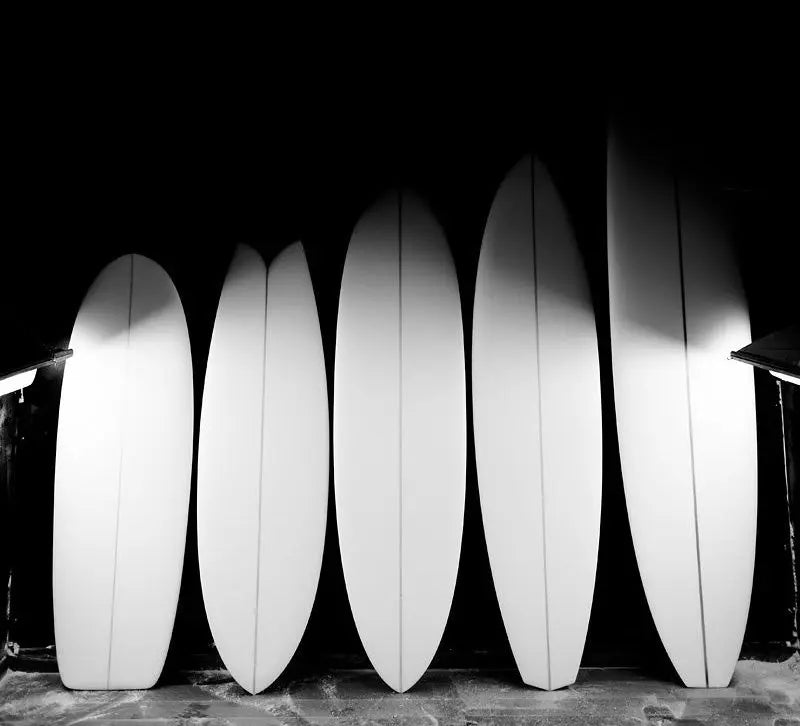
Too often, people still choose a board based on its size — "I'm 1m80, so I need a 6'2". This is an old habit that leads to buying unsuitable boards. The truly important data is volume, expressed in liters. It dictates whether you paddle well, catch waves, and if the board floats you or sinks you.
What is volume (in liters)?
A board's volume is the amount of material it contains — its buoyancy, in other words. It combines length, width, and thickness into a single number. A 25-liter board and a 35-liter board do not surf the same, even with similar dimensions.
More volume → more buoyancy → you paddle more easily, catch waves earlier, the board is more forgiving. Less volume → the board sinks, becomes more responsive and demanding, but requires good positioning and physical fitness.
How many liters for you?
The starting point is your weight, not your height. A board must carry your body, not your centimeters.
The general rule, in liters relative to your weight:
- Beginner → aim for high volume, often around 80 to 100% of your weight in liters (a 75 kg surfer starts with 60 to 75 L, foamie or longboard). Buoyancy compensates for lack of technique.
- Intermediate → between 35 and 50% of weight approximately (75 kg → 26 to 37 L depending on the program).
- Experienced / expert → often 30 to 40% of weight, sometimes less on a quality wave.
These ranges are guidelines, not strict rules. Actual skill level, wave type, and frequency of surfing all shift the equation. But the order of magnitude helps avoid the classic mistake: taking too little volume because it "looks serious," and paddling for nothing.
Why under-voluming is the #1 mistake
This is the most common mistake, especially among intermediates who want to "move up a level." A board with too little volume:
- paddles poorly and catches waves too late;
- doesn't work in soft waves — which means a large part of sessions on the Atlantic coast;
- causes fatigue, frustration, and less surfing.
A board with enough volume allows you to surf more waves, and thus progress faster. Volume isn't an admission of weakness — it's more glide time.
Volume is never read alone
Two boards with the same volume can behave very differently depending on where that volume is distributed:
- volume concentrated under the chest → paddles strongly and gets going quickly;
- volume spread into the tail → remains buoyant but less pivotal;
- a fine nose and central volume → a compromise between liveliness and buoyancy.
That's why you never reason solely on volume. It's considered with the rocker, tail, and outline. The same number can result in an easy board or a high-performance board depending on the distribution.
→ The rocker is part of this equation: see our article on board rocker. → The shape of the tail too: Board Tail Guide.
The right volume is adjusted in custom boards
For a production board, you choose the closest volume from a fixed grid. For a custom board, the shaper adjusts the volume and its distribution to your weight, skill level, and waves. This is exactly the difference between "roughly the right volume" and "the volume tailored for you."
At the Bourgneuf workshop, this is one of the first things we determine: how many liters, where, for what program. Not a grid — a conversation.
Hesitating between two volumes, or is your current board paddling poorly? We'll look at it together and define the right volume for your next UWL / Cardinal shape. Let's talk.

Share:
How to choose surf wax based on water temperature
Earplugs and ear protection for surfing: the buying guide