


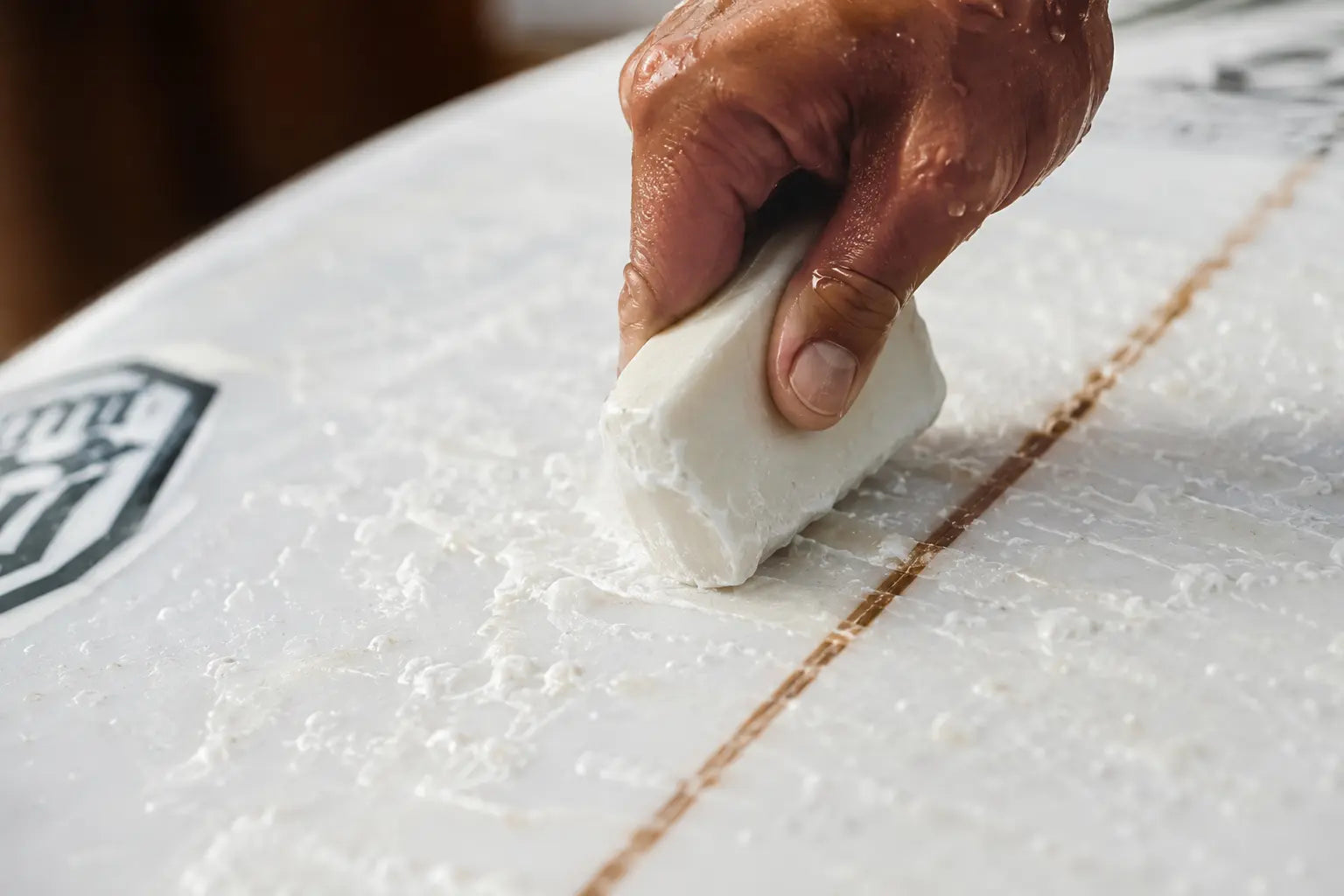
Most surfers grab whatever wax is lying around in their bag, all year long. The result: wax that's too hard and doesn't stick in winter, or too soft, melting and becoming slippery in summer. Wax isn't a detail—it's the only link between your feet and your board. And it's chosen based on a single criterion: water temperature.
Why temperature changes everything
Wax is a material that softens with heat. A wax is formulated to remain sticky—neither liquid nor glass-hard—within a precise temperature range.
- Too hot for the wax → it melts, gets greasy, you slip.
- Too cold for the wax → it hardens, vitrifies, you slip too.
A "cold water" wax used in 22°C water turns into a puddle. A "tropical" wax in 12°C water becomes a smooth slab. Hence the different ranges.
The 4 temperature ranges
Manufacturers divide the year into four ranges. The thresholds vary slightly from one brand to another—always check the packaging—but the general idea is as follows:
| Range | Water temperature | When, on the Atlantic coast |
|---|---|---|
| Cold | below ~14°C | mid-winter, early spring |
| Cool | ~14 to 19°C | spring, autumn |
| Warm | ~19 to 24°C | summer |
| Tropical | above ~24°C | travel, warm waters |
The colder the water, the softer the wax (to remain sticky despite the cold). The warmer the water, the harder it is (to avoid melting). It's counter-intuitive at first, but logical: the formula compensates for the temperature.
Base coat + top coat: the real method
The "one bar, one layer" reflex is why most boards don't grip well. The correct method is done in two steps:
- The base coat. A hard wax (often sold as "base coat" or corresponding to a warm/tropical range) applied to a clean board. It creates the small bumps that provide grip and lasts a long time. It's applied once and stays on.
- The top coat. On top, the wax corresponding to the day's water temperature. This is what provides real grip during the session. It's refreshed regularly.
This base + top logic is what separates a board that grips from a board on which you struggle to stay upright.

→ To apply (and remove) cleanly, follow our step-by-step method in Waxing and De-waxing Your Board.
Specifically, for the Atlantic coast
If you surf here all year round, you need two to three bars, not just one:
- Winter / early spring (water 9–13°C) → Cold wax.
- Spring / autumn (water 13–18°C) → Cool wax.
- Summer (water 18–22°C) → Warm wax.
- The base coat remains the same all year round.
Keep the seasonal bar in your bag and change your top coat when the water temperature shifts. It's five euros that will change your session.
The brand we recommend
Mr. Zog's Sex Wax is the historical benchmark, for a simple reason: it sticks, it lasts, and the temperature range is clear and reliable. It's what we use and keep in the shop.
→ We detail the brand and its history in Mr. Zog's Sex Wax.
Unsure which bar to get for the season? The selection is at the shop, categorized by temperature—and if you're undecided, we'll tell you which one in two seconds, depending on where you surf.
Share:
35 Years of the Shapers Club — Let's celebrate in style
Surfboard volume and literage: how to choose wisely