

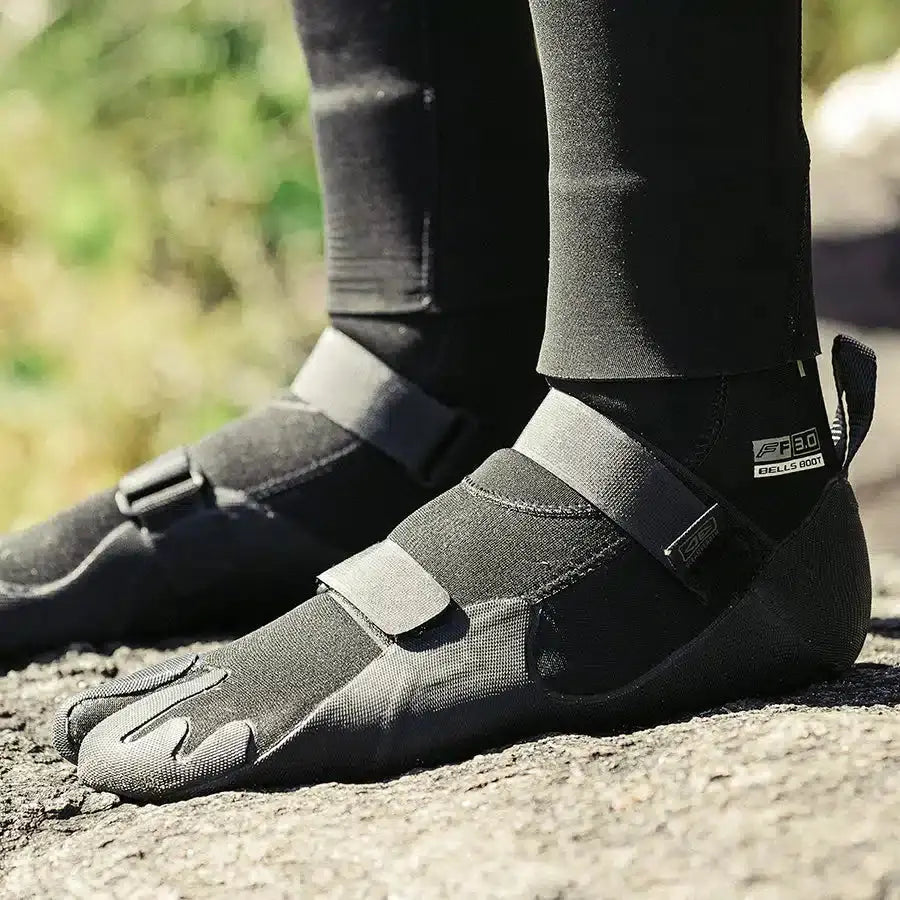
When the water starts to get cold, surf booties become essential for extending your sessions without losing your toes! But with different thicknesses, fit types, and materials, it's not always easy to know what to choose. So, how do you pick the ideal pair based on your spot, your surfing style, and your comfort? We'll explain everything.
1. What neoprene thickness to choose? 🌡
The thickness of the booties depends directly on the water temperature:
| Water Temperature | Recommended Thickness |
|---|---|
| 12 - 17°C (54 - 63°F) | 2 - 3 mm → Light and flexible 🏖 |
| 8 - 12°C (46 - 54°F) | 5 mm → Good balance between warmth and flexibility ❄ |
| < 8°C (46°F) | 7 mm → Maximum insulation for icy waters 🌊 |
💡 Tip: The thicker the booties, the warmer they are, but the less flexible they become. It's up to you to find the right balance for your practice!
2. Round toe, split toe, or hidden split toe? 🦶
The fit of the booties plays a key role in comfort and stability on the board.
✅ Round toe (toes together)
✔ Warmer, as toes warm each other.
✔ More comfortable for those who don't like toe separations.
❌ Less stability and board feel.
👉 Ideal for: those seeking comfort and warmth above all else.
✅ Split toe (big toe separated)
✔ Improves stability and balance on the board.
✔ Prevents the bootie from "floating" in the water.
❌ Less warm than round toe, as the toe is isolated.
👉 Ideal for: surfers who want maximum control and responsiveness.
✅ Hidden split toe (toe separated internally, but not visible)
✔ Best compromise between warmth and stability.
✔ No discomfort from separation like with the split toe.
✔ More board control than a classic round toe.
👉 Ideal for: those who are torn between round toe and split toe!
3. Which materials to prioritize? ♻
Not all booties are made with the same materials! Here are the main options:
✅ Classic neoprene → Petrochemical-based, offers good performance but is less environmentally friendly.
✅ Yulex → Made from natural hevea rubber 🌿, a more eco-friendly alternative.
✅ Limestone → A neoprene derived from limestone, often more flexible and durable.
💡 If you're looking for a more eco-friendly option, choose Yulex or Limestone.
4. Thin or thick sole? 🦶
The sole plays a key role in the feel of gliding and grip on the board.
🔹 Thin sole → More board feel, ideal for shortboarders 🔥
🔹 Thick sole → More protection and durability, but less feel 😏
💡 High-end models use latex to improve grip and comfort.
5. Low-cut or high-top booties? 👢
🔹 Low-cut booties (slippers) → More flexible and comfortable, but sometimes let water in.
🔹 High-top booties → More suitable for extreme conditions, offer better waterproofing and prevent cold water from entering the wetsuit.
👉 If you surf in very cold water, opt for well-fitted high-top booties.
6. The small details that make a difference 🔥
🚀 Velcro or zip closure → Improves fit and prevents the bootie from slipping.
🚀 Thermal lining (e.g., Flashbomb, Thermoforming) → Quick-drying and better insulation.
🚀 Glued and blindstitched seams (GBS) → Limits water entry and improves durability.
💡 A good fit is essential! Booties that are too large will let water in and lose their thermal efficiency.
🏄♂️ Which pair to choose according to your practice?
| Your Profile | Recommended Model |
|---|---|
| Shortboarder | 3 mm booties, thin sole, split toe 👌 |
| Longboarder | 3-5 mm booties, medium sole, round toe 🛶 |
| Winter Surfer | 5-7 mm booties, high-top booties, hidden split toe ❄ |
🌊 Ride warm with the right booties!
Choosing the right surf booties means finding the right balance between warmth, flexibility, and feel.
✔ Water temperature → 3 mm for mid-season, 5-7 mm for winter.
✔ Fit type → Round toe for warmth, split toe for stability.
✔ Materials → Limestone and Yulex for a more eco-friendly option.
✔ Sole → Thin for more feel, thick for more protection.
👉 Discover the best surf booties on Shapers Club and stay warm all winter! ❄🏄♂️
Share:
Neoprene webbed gloves for surfing: gimmick or real advantage? 🧤🏄♂️
Split toe vs round toe: what type of booties to choose for winter surfing? 🏄♂️🦶